

A workers compensation travel reimbursement form in NSW doesn’t make every trip automatically reimbursable. Travel to approved treatment and care appointments may be claimed when it relates to the injury, and the insurer assesses the request and supporting details. For a reimbursement request under the NSW workers compensation process described, the insurer has 30 days to reimburse the worker.
It’s reasonable to want clear guidance before paying for travel to an appointment. Good records show where you travelled, why the trip was needed and what you’re claiming. This article explains which travel expenses may be reimbursed, what mileage, parking and toll details to provide, and how assessment and payment work, so you can prepare your claim with confidence.
Key Takeaways
- Travel reimbursement isn’t automatic: the trip needs to relate to your injury and approved treatment or care.
- Keep travel evidence together, including receipts and a clear reason for each trip.
- For mileage, parking and tolls, accurate trip details can help explain what you’re claiming and why.
- Understanding who may claim and how requests are assessed can make the process easier to manage.
Keeping the insurer and employer informed about travel
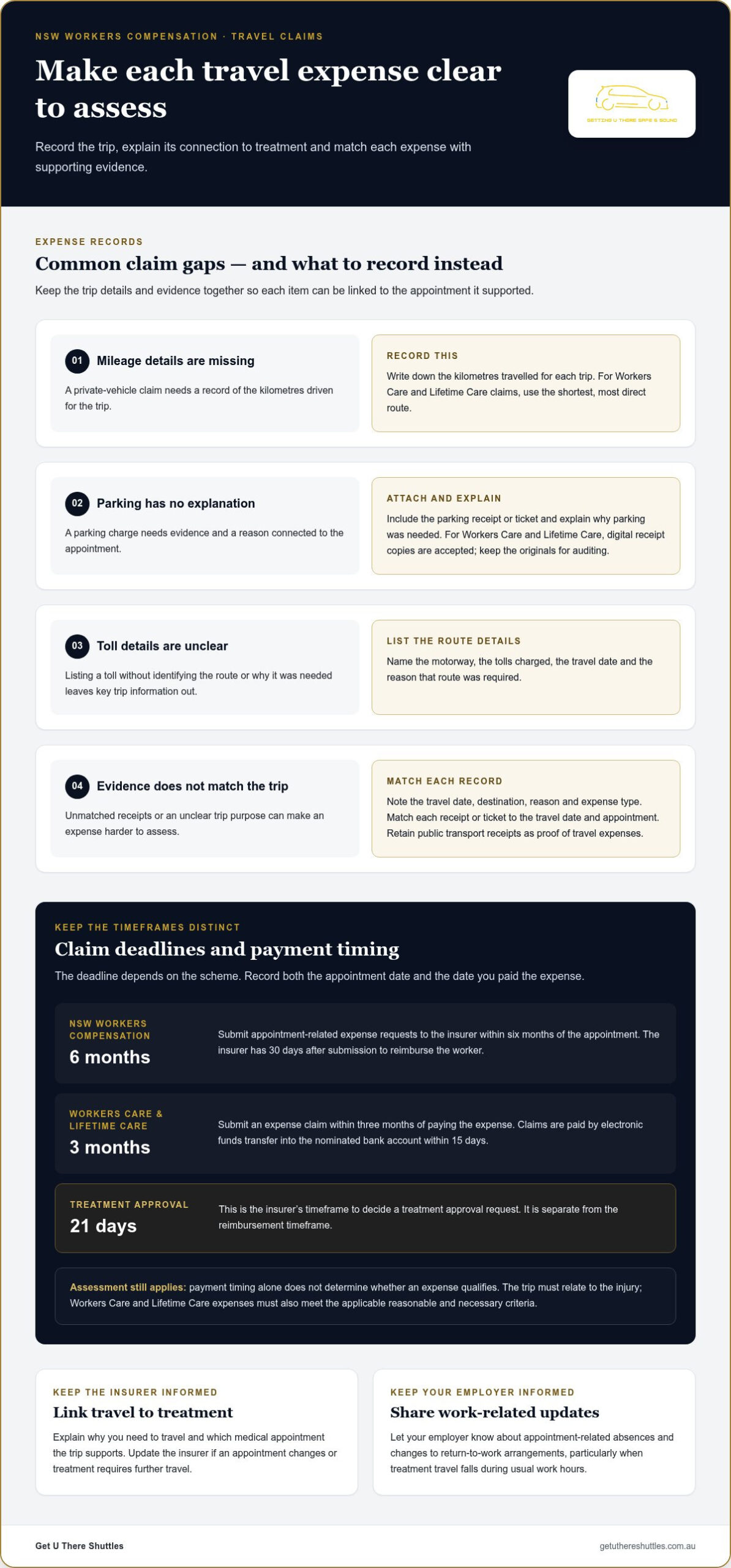
Tell the insurer handling your NSW workers compensation claim why you need to travel and which medical appointment the trip supports. Keep your employer informed about appointment-related absences and any changes to your return-to-work arrangements. For example, explain when treatment requires travel during your usual work hours rather than leaving your absence unexplained.
Where to submit a workers compensation travel reimbursement claim in NSW? Send your reimbursement request to the insurer with appointment details and supporting evidence. For expenses incurred at an appointment, submit the request within six months of that appointment.
Make each claim easier to assess by recording the travel date, destination, reason for the trip and expense type. A NSW Workers Care or Lifetime Care expense claim can cover multiple expenses, and digital receipt copies are accepted. Keep original receipts for auditing purposes. Retain public transport receipts as proof of travel expenses claimed in NSW workers compensation matters.
Update the insurer if an appointment changes or your treatment requires further travel. A clear record links each trip to the injury and care received. For Workers Care and Lifetime Care expenses, check whether the expense may be reimbursed and, if possible, seek verbal approval before paying. These schemes advise submitting expense claims within three months of payment, which is separate from the six-month appointment deadline.
What happens if a NSW workers compensation travel reimbursement claim is rejected? Ask the insurer to provide the reason in writing and identify the trip or expense it declined. Supply any missing records, such as a public transport receipt or appointment details, and ask how to request a review if you disagree with the decision.
Keep copies of your claim, receipts and insurer correspondence together. If your employer needs to coordinate work arrangements around treatment, share relevant appointment updates promptly and limit personal medical details to what is needed for that purpose.
Mileage, parking and toll claim requirements
For a travel claim related to injury treatment, record each expense clearly. The details you need differ for private-vehicle mileage, parking and motorway tolls.
Claiming mileage, parking and tolls
Mileage claims need the kilometres travelled for each trip, using the shortest, most direct route for Workers Care and Lifetime Care claims. For NSW workers compensation, keep a record of kilometres driven in a private vehicle. The reimbursement rate for travel to medical, hospital and rehabilitation services is .58 cents per kilometre. For parking, include the receipt or ticket and explain why parking was needed. A toll claim should name the motorway, tolls charged, travel date and reason that route was required.
Receipts and supporting documents
Receipts and trip records support each expense and link it to the treatment visit. Retain public transport receipts as proof of travel expenses claimed in NSW workers compensation matters. For Workers Care and Lifetime Care, include a parking receipt or ticket and explain why parking was needed. Digital receipt copies are accepted for these claims, but retain the originals for auditing. Match each document to the travel date and appointment.
Completing the reimbursement form
To complete a NSW workers compensation travel reimbursement form, enter details that identify the trip and expense. State the travel date and reason, such as attending treatment for your injury. For private-vehicle mileage, record the kilometres driven. For tolls, list the motorway and tolls charged, and explain why they were required. Attach relevant receipts or tickets, including public transport proof, so the insurer can assess the claim against your supporting records.
Before submitting, compare every listed expense with its evidence. A missing parking explanation or unclear motorway detail can make the claim harder to assess. If arranging transport to treatment would help with your travel planning, organise your medical appointment travel.
Reimbursement assessment and payment timing
Assessment depends on the scheme, the injury-related purpose of the trip and the records provided. For NSW workers compensation, the insurer assesses requests for expenses incurred at an appointment. Workers Care and Lifetime Care expenses may be reimbursed if they relate to the injury and meet the applicable reasonable and necessary criteria.
NSW workers compensation travel reimbursement claim deadlines: Submit requests for appointment-related expenses to the insurer within six months of the appointment. For Workers Care and Lifetime Care, submit an expense claim within three months of paying the expense. These deadlines start from different dates, so record both the appointment and payment dates.
For a workers compensation reimbursement request, the insurer has 30 days to reimburse the worker after submission. This period concerns reimbursement, not a decision about treatment approval. If you’re seeking approval for treatment, the insurer has 21 days to decide that request. Keeping the two processes separate helps you understand which timeframe applies to your claim.
Workers Care and Lifetime Care expense claims are paid by electronic funds transfer into the nominated bank account within 15 days. Check that the claim includes the relevant trip reason and supporting documents before submission. For example, a medical appointment travel claim should make clear which appointment the journey supported. Keep the submitted claim and evidence together, so you can refer to the same details if the insurer asks about an expense.
Payment timing alone doesn’t determine whether an expense qualifies. Assessment considers the expense’s connection to the injury and, for Workers Care and Lifetime Care, whether it meets reasonable and necessary criteria. Travel for approved treatment differs from a trip for an unrelated purpose. Clear appointment details and records help show how each expense relates to care.
Use the deadline that applies to your scheme and record when the insurer receives your request. If reimbursement has not arrived after the relevant period, refer to your submission date and claim records when following up. Keep correspondence with your claim documents, including any insurer decision about treatment or travel expenses.
Who can claim travel expenses for a NSW workers compensation injury?
In NSW, travel expenses may be claimed when they relate to an injury and travel to approved treatment or care. Workers Care and Lifetime Care identify injury-related mileage and fares for approved appointments as claimable expenses. The appointment’s connection to the injury and the applicable scheme both matter.
A worker travelling to a medical appointment for workplace injury treatment may have a relevant travel expense to claim. A trip unrelated to the injury does not meet this injury-related basis. Keep appointment details and travel records together so the purpose of the journey is clear.
Relevant expenses depend partly on how the worker travelled. A public transport fare to an approved treatment appointment, for example, differs from kilometres driven in a private vehicle. Link either expense to the appointment and support it with appropriate records. For parking and tolls, include details showing their connection to the treatment trip.
The scheme distinction matters. Workers Care and Lifetime Care claims use the injury-related and reasonable and necessary criteria that apply to those schemes. For NSW workers compensation, submit requests for expenses incurred at appointments to the insurer. Identify the relevant claim and appointment rather than assuming every journey is covered.
Before claiming, note the appointment date, treatment purpose and travel method. For example, a worker attending rehabilitation can record the journey and retain fare evidence. The insurer or scheme can then assess the expense based on its connection to injury-related care and the supporting documents. Clear records also distinguish treatment travel from ordinary commuting or personal trips.
Travel support can also matter when an injury makes reaching treatment difficult. If arranging transport would help you attend a workers compensation appointment, request workers compensation transportation for your journey.
Get U There Shuttles: Airport Transfers
Get U There Shuttles provides Worker’s compensation transportation and medical appointment transfers for treatment travel. To request a quote, provide your pick-up and drop-off locations, travel date and time, and any passenger requirements. These details help the team prepare an accurate, fixed upfront transport quote.
Complete the enquiry form with your journey information, and Get U There Shuttles will be in touch within 24 hours. If your booking is urgent or you need help completing the form, call 1300 66 88 48. Airport Transfers are also available for journeys involving airport travel.
Contact Get U There Shuttles to request a quote for your transport needs.
Make your next treatment journey easier to plan
Keep transport planning and reimbursement paperwork as separate parts of your recovery arrangements. A clear booking plan helps you focus on getting to treatment, while your claim records explain the travel expense to the insurer. Use the workers compensation travel reimbursement form in NSW to present trip details clearly, and keep a copy of the documents you submit.
If you need transport to a workplace injury appointment, choose an arrangement that suits the journey and your needs. Get U There Shuttles provides Worker’s compensation transportation, Airport Transfers and Cruise Ship Transfers, with bookings arranged around your trip details.
For a transport enquiry, share your pick-up location, destination, appointment time and any requirements relevant to the journey. This gives the team practical information to respond to your request. Contact Get U There Shuttles about your transport needs, and take the next step with your travel arrangements.
Frequently Asked Questions
Does a claim automatically cover all expenses?
No. A claim being lodged doesn’t itself establish that every expense is payable. The relevant scheme assesses whether an expense meets its criteria, and treatment approval is a separate decision from reimbursement. For NSW workers compensation treatment approval requests, the insurer has 21 days to decide. Keep approval correspondence with your claim records so you can distinguish treatment decisions from expense decisions.
What expenses are covered by workers compensation in NSW?
Depending on the worker’s circumstances, claimable expenses can extend beyond travel to medical, hospital and rehabilitation care. Medical expenses may be claimable for two years after weekly payments cease where the worker has at least 10% permanent impairment. Different periods apply at higher impairment levels. These are medical-expense timeframes, not travel-claim deadlines, so avoid treating them as interchangeable.
What travel costs are reimbursable under NSW workers compensation?
For Workers Care and Lifetime Care, injury-related mileage and fares for approved treatment and care appointments are recognised travel expense types. The central distinction is the trip’s purpose: travel linked to care for the injury is different from a journey for an unrelated reason. Keep each journey identifiable as part of the treatment plan rather than grouping unrelated travel together.
What are the NSW workers compensation travel reimbursement rates per kilometre in 2026?
The rate is .58 cents per kilometre for travel to medical, hospital and rehabilitation services. This is a reimbursement rate, not a general allowance for all driving. Record the kilometres associated with eligible treatment travel, and keep the appointment purpose clear so the insurer can assess the claim.
Are parking, tolls, taxis and public transport reimbursed for NSW workers compensation?
Parking, tolls and public transport fares may be relevant expenses if they relate to injury care and meet the applicable claim criteria. A taxi fare is not automatically payable simply because you used it to reach treatment. Eligibility depends on the trip’s purpose and the relevant scheme’s requirements, not the transport method alone.
Can an injured worker claim travel expenses for medical treatment outside NSW?
An appointment outside NSW does not, by itself, mean travel costs are reimbursable. The key questions are whether the journey relates to the accepted injury, whether the treatment is approved and whether the expense meets the applicable scheme criteria. Keep appointment details and travel evidence together, and clearly identify the treatment location in your claim to the insurer.