

The key distinction is who is travelling and why. In NSW, NDIS travel allowance usually refers to eligible provider travel costs connected with delivering an NDIS support. It is not the same as a participant’s NDIS transport funding or Centrelink Mobility Allowance. Provider travel must be agreed in advance and included in the service agreement before it can be billed.
These terms can be confusing because provider travel time, kilometres and participant transport funding follow different rules. This guide explains NDIS travel allowance in NSW, how provider time and mileage claims work, and what to agree on before travel charges apply. It also distinguishes participant transport funding from Mobility Allowance, helping you identify which arrangement relates to your circumstances.
Key Takeaways
- Provider travel claims are tied to the support delivered, and time limits depend on the participant’s Modified Monash Model area.
- Agree on travel charges and the applicable rate in advance, then include the arrangement in the service agreement.
- Keep clear records of travel time, kilometres and related receipts; NDIS travel records must be retained for seven years.
- Separate provider travel claims from participant transport funding, as they serve different purposes and follow different rules.
- Mobility Allowance and NDIS transport funding aren’t interchangeable, so understanding which applies can help clarify the support available.
Time-based travel claims and Modified Monash Model limits
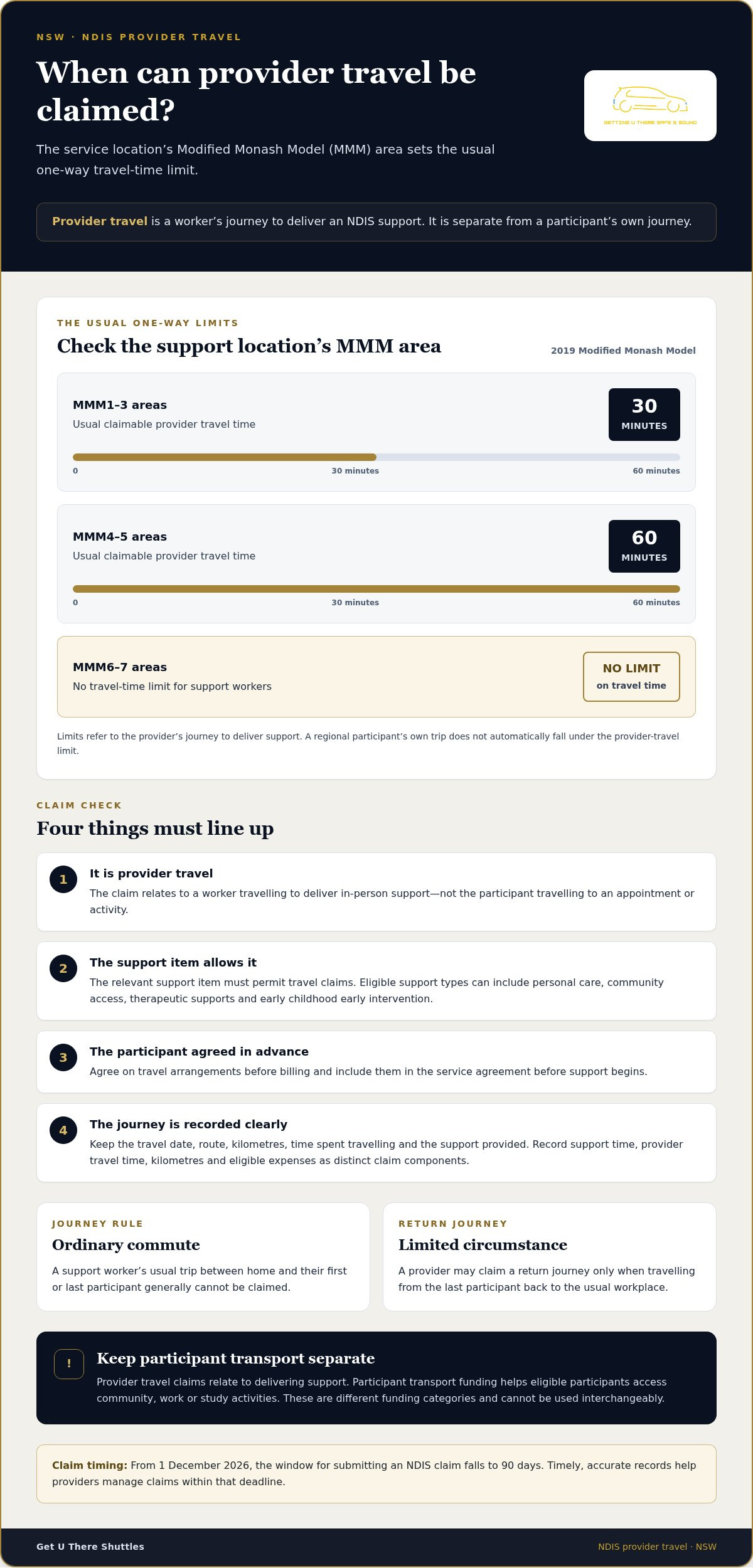
Provider travel means a worker’s journey to deliver an NDIS support. Participant transport funding is separate: provider travel claims relate to delivering support, while transport funding helps eligible participants access community, work or study activities. These are distinct funding categories and cannot be used interchangeably.
In NSW, a provider’s claimable travel time depends on the service location’s Modified Monash Model (MMM) classification. Under the 2019 Modified Monash Model, which the NDIA uses to classify postcodes, the usual limits are 30 minutes one way in MMM1-3 areas and 60 minutes one way in MMM4-5 areas. There is no travel-time limit for support workers in MMM6-7 areas.
For regional appointments, first distinguish the worker’s journey to deliver support from the participant’s journey to an appointment. The 60-minute limit applies to provider travel in MMM4-5 areas, not automatically to every regional trip. A postcode’s MMM classification and the support item’s rules determine the applicable provider-travel limit.
Who can claim NDIS travel costs in NSW? A provider can claim eligible travel connected with in-person support when the relevant support item permits travel claims and the participant has agreed. A support worker’s ordinary journey between home and their first or last participant generally cannot be claimed.
Eligible support types can include personal care, community access, therapeutic supports and early childhood early intervention, which are commonly delivered across NSW by providers such as 24/7 Care Services. Providers may also claim eligible travel expenses when accompanying participants to funded community or educational activities. Time and travel expenses may both be claimed, subject to NDIS requirements, but must be recorded and billed as distinct claim components.
Before billing, the provider and participant must agree to travel in advance and include it in their service agreement. If a worker travels between multiple participants, travel costs should be divided fairly and negotiated with everyone involved. A provider may claim a return journey only when travelling from the last participant back to the usual workplace.
Keep records that distinguish support time, provider travel time, kilometres and eligible expenses. These details help show how a claim relates to the delivered support and agreed arrangements. From 1 December 2026, the window for submitting an NDIS claim falls to 90 days. Timely, accurate records help providers manage claims within that deadline.
Price limits also affect claims, but they do not change the MMM travel-time limits. Price limits for some supports delivered by unregistered NDIS providers fall by 10% on 1 January 2027. Providers must apply the relevant limit for the support delivered and the date of service, rather than treating travel time as a separate unrestricted allowance.
Travel time rates and participant agreements
The participant and provider must agree on travel-time charges before the provider bills them. Record the terms in the service agreement before support begins. It should explain when travel may be charged, how the rate is set and how travel entries will appear on invoices.
The travel-time rate should be the same as or lower than the hourly rate for the support delivered. Agree on the rate before the worker travels, not afterwards. A provider may propose a lower travel rate, and participants, nominees and support coordinators can discuss the proposed charges and decide whether to agree.
For example, if a therapist charges an hourly support rate, half an hour of travel charged at that same rate would equal half the hourly rate. This illustrates the calculation, not a required charge. The support item’s rules and applicable price limit still apply. Participants can discuss a lower rate or decide whether to accept travel charges.
Set out the circumstances in the service agreement. Specify the support being delivered, when provider travel applies, how time is calculated and how expenses such as tolls or parking are handled. Clear terms help participants understand how the arrangement may affect their plan funding before they approve support.
If a worker travels to support multiple participants, travel costs should be shared between them and negotiated with everyone involved. One participant should not automatically be billed for the entire journey. The agreed allocation and each participant’s share should be clear in the relevant service arrangements.
Invoices should distinguish the support itself, provider travel time and other provider travel expenses. Parking and tolls, for example, are separate from the worker’s travel time. Provider travel costs must be billed separately from travel time and support, using the “Provider Travel – non-labour costs” support item. The provider must use the same support item code as for the service delivered.
When a support worker accompanies a participant on an outing or assists with their transport, the worker may charge the support item’s hourly rate for relevant support, if agreed. This is a charge for support delivered during the activity, not automatically a provider travel claim. Keeping these categories separate helps participants understand how each claim uses their funding.
For a journey to an NDIS appointment, review the agreed travel terms and transport arrangements before booking. This helps ensure the booking details align with the support arrangements already agreed.
Mileage evidence and recordkeeping
For an NDIS travel claim, keep a clear record showing how the journey relates to the support delivered. An NDIS provider should note the travel date, route, kilometres, time spent travelling and support provided. These details help explain the claim and distinguish provider travel from a participant’s own trip for disability support.
Record mileage separately from travel time and other expenses. A worker’s journey to a participant, for example, may involve kilometres travelled and time on the road, while parking or tolls are separate items. Keep relevant receipts with the journey record so each expense can be matched to the trip.
For eligible standard vehicle travel, show how the claimed kilometres were calculated and apply the relevant NDIS non-labour limit. Keep that calculation separate from travel time and incidental expenses. This helps participants see what the mileage entry relates to and how it was worked out.
A useful record for each trip can include:
- The date and purpose of the journey, linked to the NDIS support.
- The route or destination, with the kilometres included in the claim.
- Travel start and finish times, separate from support delivery time.
- Receipts for tolls and parking, matched to the relevant trip.
- The mileage calculation and any other eligible travel expenses charged.
If a worker drives between participants, record the route and how the journey relates to each person’s support. If travel costs are allocated across participants, document the basis for that allocation. This helps each person understand their share rather than leaving one participant to account for the full trip without context.
Keep travel-time records and supporting documents together, including receipts for tolls and parking. NDIS travel records must be retained for at least seven years. Sorting entries by participant and service date can help providers retrieve relevant evidence when reviewing a claim.
Clear records also help participants compare an invoice with the agreed service terms. They can see whether kilometres, travel time and expenses appear as distinct entries rather than being combined without explanation. For a mileage claim, the route record and calculation should support the kilometres charged.
NDIS documentation should make the connection between a journey and the support delivered clear. A complete trip entry helps providers explain the claim and gives participants a clearer view of how travel relates to their available funding.
What Is the NDIS Travel Allowance?
In NSW, “NDIS travel allowance” can refer to two different things: a provider’s claim for travel linked to delivering support, or transport funding in a participant’s plan. The first relates to the provider’s work; the second helps an eligible participant access activities. Knowing which arrangement applies prevents provider travel claims being confused with a participant’s own transport funding.
Provider travel is connected to an NDIS support, not a general contribution towards a participant’s everyday journeys. A provider may claim eligible travel when delivering support face-to-face and when the relevant support item allows it. The claim must relate directly to providing that service. A worker’s journey to deliver agreed in-person support, for example, differs from a participant travelling independently to a personal appointment.
Participant transport funding addresses a different need. It may be included in a plan when a person’s disability prevents them from travelling independently on public transport. Its purpose is to support access to community activities, work or study. Significant difficulty using public transport because of disability is relevant to eligibility, but funding must also relate to the participant’s disability and goals.
NDIS transport supports must represent value for money and must not be better provided by informal supports or mainstream services. The purpose of the trip and the participant’s circumstances therefore matter. A journey connected with a disability-related goal may be considered differently from routine travel unrelated to the person’s support needs.
Transport funding is usually paid directly to participants in regular instalments. It is not intended to cover general travel expenses such as fuel or family transport, or costs such as general car maintenance, insurance and vehicle registration. It supports the participant’s transport needs, not general vehicle ownership.
For children, the NDIS may consider whether transport support is appropriate for the child’s age and may expect parents to transport young children. A child’s NDIS participation does not, by itself, mean every school or activity journey should be funded through their plan.
To identify the relevant arrangement, first ask who is travelling and why. If a worker is travelling to deliver in-person NDIS support, provider travel rules apply. If a participant needs help reaching community, work or study activities because disability affects their ability to use public transport independently, plan transport funding may be relevant.
In short, NDIS travel allowance explained in NSW means distinguishing a provider’s support-related travel claims from participant transport funding. The first covers travel to deliver support; the second relates to an eligible participant’s access needs and plan goals.
Mobility Allowance and NDIS transport funding
Mobility Allowance and NDIS transport funding are different arrangements. A person’s access to these arrangements may depend on their individual circumstances. NDIS transport funding may be included in a plan when disability prevents someone from travelling independently on public transport.
NDIS transport funding supports access to community activities, work or study. Eligibility relates to how disability affects travel and the participant’s goals. The NDIS also considers whether the support represents value for money and whether informal supports or mainstream services could provide it instead.
Transport funding is usually paid directly to participants in regular instalments. It is not a general contribution towards owning or running a vehicle. Fuel, general car maintenance, insurance and vehicle registration are not funded through NDIS transport funding. General travel costs, including family transport, are also outside its intended purpose.
Provider travel is separate. It covers travel connected with delivering an NDIS support, and any claim must follow the relevant support item’s rules and applicable NDIS Pricing Arrangements and Price Limits. Those rules distinguish provider travel expenses from participant transport funding, so the two should not be treated as interchangeable.
Accessible transport has separate activity-based arrangements for eligible provider travel. The applicable limits depend on the type of transport and support being delivered. Participants should distinguish a provider’s claim for a support-related journey from funding intended for their own transport needs.
In NSW, the Taxi Transport Subsidy Scheme is another distinct arrangement. A participant cannot claim an NDIS transport subsidy and a state taxi subsidy for the same trip, but may use the schemes on different trips. This distinction can matter when planning separate journeys for different activities.
School travel has separate arrangements too. The NSW Assisted School Travel Program provides eligible students with in-kind transport between home and school. It is funded by the NSW Government, not the NDIS, and parents or carers do not manage that transport through a student’s NDIS plan.
To identify the relevant arrangement, consider who is travelling, the trip’s purpose and how disability affects the journey. This helps distinguish provider travel, participant transport funding and separate NSW transport schemes.
Get U There Shuttles: Airport Transfers
Get U There Shuttles provides NDIS transport and medical appointment transfers across Sydney and NSW. The company also offers Airport Transfers, Cruise Ship Transfers and transport for workers’ compensation journeys, with fixed, upfront pricing and a professional driver.
For a tailored quote, provide your pickup and destination details, travel date and time, passenger numbers, and any relevant mobility or assistance requirements. For airport travel, include your flight information so pickup arrangements can be considered alongside your itinerary. Complete your details through the website, and Get U There Shuttles will be in touch within 24 hours with a quote.
If your booking is urgent or you need help completing the form, call 1300 66 88 48. Contact Get U There Shuttles to discuss your transport requirements.
Plan the next journey with clarity
Understanding how NDIS travel allowance works in NSW can help you distinguish a provider’s service-related travel from your own transport needs. For your next journey, clarify its purpose and arrangements from the outset, especially when transport is connected with an appointment or community activity. This gives you a practical basis for discussing the trip and the support that may apply.
If you need transport, note the journey details that matter to you, including pickup and destination, timing and any assistance requirements. A clear plan makes it easier to arrange transport suited to your circumstances without confusing the booking with an NDIS provider travel claim.
For help arranging a journey, contact Get U There Shuttles about transport. Take the next step with the details of your trip in hand.
Frequently Asked Questions
What is NDIS Transport Funding?
NDIS transport funding is support in a participant’s plan for disability-related travel needs. It may help someone who cannot travel independently on public transport access community activities, work or study. For example, a participant might use their funding to help reach a regular work placement. This differs from a provider’s claim for travel time or vehicle expenses incurred while delivering an NDIS support.
What Counts as ‘Reasonable and Necessary’ Transport Support?
Transport support must relate to the participant’s disability and goals, represent value for money, and not be better provided by informal supports or mainstream services. The NDIS may consider how a transport arrangement helps someone take part in a goal-related activity and whether another suitable support is available. For a child, age also matters: the NDIS may expect parents to transport young children.
What is the NDIS travel allowance in NSW?
In NSW, the phrase can describe provider travel claims or a participant’s plan funding for transport. Provider travel relates to delivering an eligible NDIS support; participant funding supports eligible disability-related travel needs. The distinction matters because a provider’s journey to a support session isn’t the same as a participant’s trip to an activity. The rules for the claim depend on which arrangement applies.
What NDIS travel costs can participants claim?
Participants generally use transport funding provided through their plan rather than claiming a provider’s trip expenses as their own. The funding is not for general fuel, vehicle maintenance, insurance or registration. A participant should not treat ordinary household car expenses as an NDIS transport claim. A provider’s eligible travel expenses, such as tolls or parking connected with delivering support, belong to a separate claim category.
What are the current NDIS travel rates and limits in Australia?
These figures relate to different transport arrangements, not a single universal allowance. Provider travel-time limits also vary by the service location’s Modified Monash Model classification and the support item’s rules.
How are participant transport costs funded under the NDIS?
NDIS transport funding is usually paid directly to participants in regular instalments. It can support eligible travel linked to community access, work or study, rather than general household transport costs. Someone might, for example, use plan transport funding for travel associated with a work goal. A participant cannot claim an NDIS transport subsidy and a NSW Taxi Transport Subsidy Scheme subsidy for the same trip.
How do I include travel costs in an NDIS plan or service agreement?
Plan funding and provider travel arrangements work differently. If you need participant transport support, describe how disability affects your travel and how transport would support your goals. For provider travel, discuss proposed charges before support starts and document the agreed terms in the service agreement. Specify whether travel time or eligible trip expenses may apply, keeping those arrangements distinct from plan-level transport funding.
What evidence or records are needed to claim NDIS travel costs?
For provider claims, keep records connecting each journey to the support delivered. A useful entry includes the service date, destination, kilometres, travel time and purpose, with toll or parking receipts attached where relevant. Retain NDIS travel records for at least seven years. Participants reviewing an invoice can compare its separate travel entries with the agreed service terms and request a clear explanation of any calculation.