

To avoid the Sydney Airport taxi queue, compare the airport train, rideshare and a pre-booked transfer before you land. The train may suit a journey with convenient rail connections, but passengers pay a station access fee as well as the fare. Rideshare and pre-booked transfers offer alternatives to the taxi rank.
After a flight, waiting with luggage or working out where to meet your ride can add stress. Choosing how you’ll travel before arrival gives you time to weigh practical factors, including your destination, luggage and how much coordination you want to manage.
This guide compares the train, rideshare and pre-booked transfers, and explains how a busy terminal kerb or your route can affect pick-up arrangements. You’ll also find practical steps to reduce unnecessary detours and make your onward journey from the airport more straightforward.
Key Takeaways
- Compare the airport train, rideshare and a pre-booked transfer against your destination, luggage and preferred pick-up arrangements.
- Learn why taxi queue times can vary and how peak-period congestion affects the airport pick-up experience.
- Understand how route choice and terminal traffic can contribute to unnecessary detours and delays.
- Use official taxi ranks and avoid accepting unsolicited ride offers inside the terminal.
- Find out how planning your onward transport in advance can make your airport arrival more straightforward.
Airport train, rideshare and pre-booked transfer alternatives
To avoid the Sydney Airport taxi queue, compare your onward journey before landing. The airport train can suit passengers whose destination connects conveniently with the rail network. Consider how far you’ll need to travel from the station, especially with luggage or children. The train is a useful option when its route and connections match your plans, but less convenient if your accommodation is well away from a station.
Rideshare lets you travel by road without joining the taxi rank. Pick-up points depend on the service and airport arrangements, so follow the app’s instructions and terminal signs. At the domestic terminal, check the nominated pick-up zone before leaving arrivals. Don’t assume the taxi rank is also the rideshare meeting point. If you’re travelling with others, agree on a meeting place before heading outside.
Before accepting a rideshare, match the vehicle and driver details in the app. Use the app’s trip information and tracking to review the journey and share the details with someone expecting you. Keep the app open until you’ve identified the correct vehicle, especially when several cars arrive at the same collection area.
A pre-booked airport transfer suits passengers who want to arrange pick-up before travelling. You can provide your flight information, destination and passenger requirements when booking. These details help coordinate the collection around your arrival and the journey you need. Advance planning may be useful if you have luggage, are travelling with family or need to reach a scheduled appointment.
Each option calls for different planning. For the train, check that the station and connections work for your destination. For rideshare, know where the app directs you to meet the driver. For a pre-booked transfer, provide accurate travel and pick-up details before departure. Consider the whole trip from terminal to final stop, not just how you’ll leave the airport.
Your choice also depends on how much coordination you want to manage after landing. A rail journey means following the route and making any necessary connections. Rideshare involves arranging pick-up through an app and finding the assigned vehicle. A pre-booked transfer lets you organise the journey in advance. Consider your luggage, companions and destination to decide what best suits your arrival.
Whichever option you choose, confirm the terminal and collection arrangements before leaving arrivals. Follow the signs and instructions for your transport method. A clear meeting point and destination can make the next part of your journey more straightforward and help you avoid unnecessary movement around the terminal.
Avoiding unnecessary routes and charges
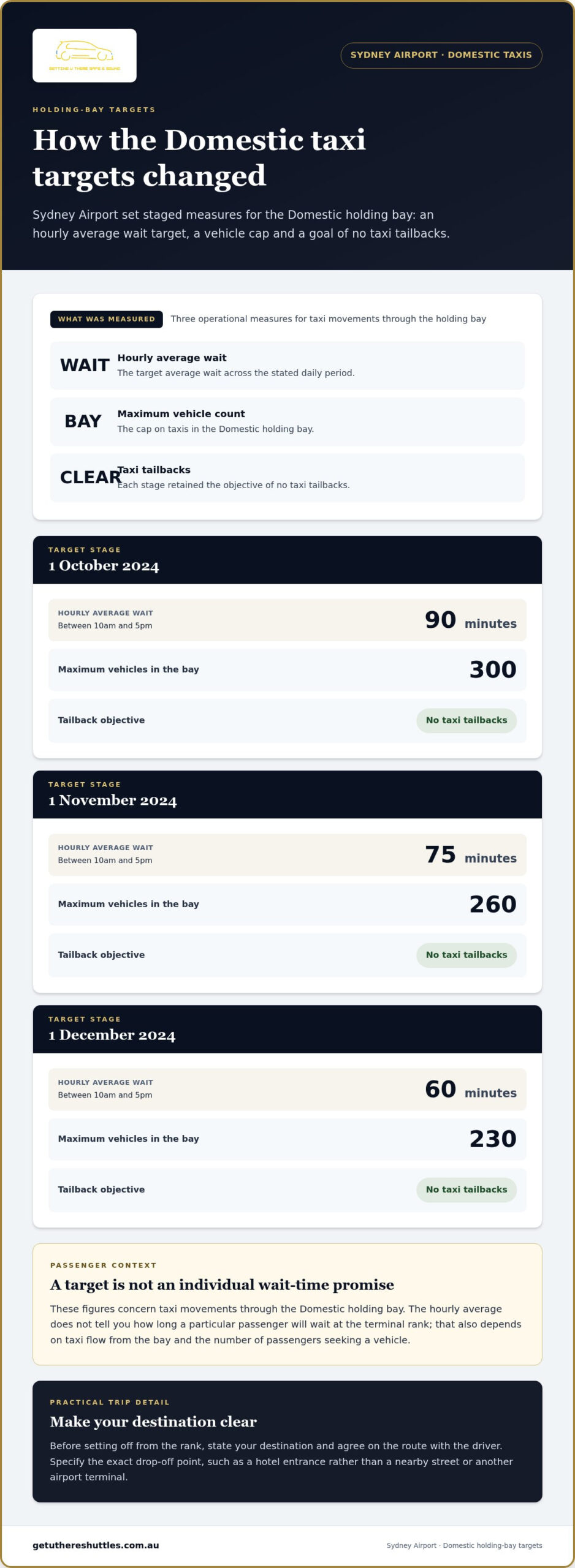
Sydney Airport’s proposed Domestic holding-bay targets set out how taxi congestion was to be measured and managed. The staged targets paired an hourly average wait with a maximum vehicle count and a requirement to prevent taxi tailbacks. These figures concerned taxi movements through the holding bay, not a passenger’s route after leaving the airport. Keeping the two separate helps clarify what affects your journey.
For 1 October 2024, the target was an hourly average wait of no more than 90 minutes between 10am and 5pm. The holding bay was to have a maximum of 300 vehicles, with no taxi tailbacks. For passengers, the useful context is that these were operational measures for the Domestic taxi supply. They were not a timetable promising when an individual taxi would reach the rank.
The next stage was set for 1 November 2024. Its target reduced the hourly average wait to no more than 75 minutes between 10am and 5pm, capped the bay at 260 vehicles and retained the no-tailbacks objective. On 1 December 2024, the target became no more than 60 minutes, a maximum of 230 vehicles and no taxi tailbacks. The dates show a planned progression, not a measurement of every passenger’s wait.
When comparing these targets, distinguish the hourly average wait from the vehicle limit. The first describes an average over the stated period; the second sets the maximum number of taxis in the Domestic holding bay. Neither tells you how long a particular passenger will wait at the terminal rank. That wait also depends on taxi flow from the bay and the number of passengers seeking a vehicle.
Sydney Airport advised taxi drivers to limit holding-bay waits to less than an hour and avoid the Domestic precinct when the bay was full or nearly full. It also said taxis should not use the airport as a place to wait for two or more hours. This helps explain why vehicles may be directed away from a congested precinct rather than continuing to circulate.
Planning your route as a passenger is a separate consideration. Before setting off from the rank, state your destination clearly and agree on the route with the driver. For example, distinguish a hotel entrance from a nearby street or another airport terminal. A precise destination gives the driver a clear endpoint and reduces confusion about where you need to be dropped off.
The 2024 targets describe a staged approach to managing taxi supply at the Domestic holding bay. Use them as context for airport operations, not as a prediction of your own trip. For your journey, clear destination details and an agreed drop-off point are the practical steps that help avoid unnecessary route changes.
Avoiding congestion at the International Terminal
At Sydney Airport’s International Terminal, taxi drivers are advised not to wait on nearby local roads or shift congestion towards the terminal. Vehicles stopping or circling outside the intended pick-up flow can add pressure around arrivals. Use the collection arrangement for your chosen ride rather than asking a driver to meet at an improvised roadside spot.
Before leaving arrivals, check the pick-up instructions for your transport option. If you’ve booked a ride, follow its stated meeting point instead of assuming every vehicle collects from the same kerb. A rideshare passenger and someone taking a taxi, for example, may need to follow different arrangements. Confirm the terminal and pick-up location with your driver before walking outside.
International arrivals can mean handling luggage, travel companions and unfamiliar surroundings. Decide who will keep the bags together while another person checks the collection details. If you’re travelling alone, pause in a suitable indoor area to read your booking message before heading to the kerb. This avoids searching for instructions while moving through a busy terminal entrance.
A driver who can’t stop at the spot you expected may need to follow airport traffic arrangements. Don’t ask them to wait on a local road or make an unscheduled loop around the terminal. Instead, compare your booking details with the driver’s message and agree on the designated meeting point. Clear communication can prevent you and your driver from heading to different parts of Sydney Airport.
If your flight arrives at the International Terminal but your onward plans involve another airport area, distinguish the arrival terminal from your final destination. Tell your driver the correct destination, not simply “the airport”. For example, if you’re meeting someone at another terminal, name it clearly. This helps avoid travelling to the wrong part of the precinct and making an extra vehicle journey.
Congestion can affect private pick-ups too, especially if a driver waits in the wrong place or circles while looking for a passenger. Keep your phone available, read the arrival message and respond with a clear location. If you can’t see the vehicle, contact the driver through the agreed channel rather than walking between kerbs while they search.
These steps won’t remove airport traffic, but they can reduce avoidable confusion at the International Terminal. Confirm your pick-up point, share it with everyone in your group and avoid requesting a roadside meeting. Clear collection details help your driver follow airport arrangements without unnecessary waiting or movement near arrivals.
How long are taxi queues at Sydney Airport during peak times?
There isn’t one fixed wait time for passengers at Sydney Airport’s taxi ranks. Reports about drivers waiting in the holding bay describe a different part of the process, not a guaranteed passenger queue duration. Former taxi drivers have reported waiting several hours for a fare, including one who sometimes waited an hour or more at night. Another driver reported waits of up to two hours.
Those accounts show why a single estimate can mislead. A driver’s holding-bay wait happens before reaching the rank, while passengers wait at the terminal for an available taxi. The waits are related, but they aren’t interchangeable. Sydney Airport has taxi ranks at each terminal, with supervisors on hand during peak times to help taxis flow smoothly.
Demand and vehicle flow can change throughout the day. Sydney Airport said passenger numbers were limited between 10am and 4.30pm, making this an important period for drivers to avoid a full or nearly full Domestic holding bay. The Domestic holding bay has space for 300 vehicles. These operational details help explain how congestion can affect taxi supply, but they don’t establish how long a passenger will wait.
For your arrival, consider what affects the queue: the number of passengers seeking taxis, how quickly vehicles leave the rank and congestion in the airport precinct. A group needing a larger vehicle may have different requirements from a solo passenger with one bag. Ask the rank supervisor for help if you need a taxi with a particular capacity or accessibility feature.
Build flexibility into plans that depend on a taxi. If you have a connection, appointment or event, allow time to leave the terminal and reach your destination. Don’t treat driver holding-bay reports as a forecast for your arrival. Instead, decide before landing whether the official taxi rank suits your plans or another transport arrangement better fits your schedule.
Sydney Airport planned to show live taxi holding-bay wait times on its website by the end of September. This information concerns the holding bay, not necessarily the passenger queue at a terminal rank. If available when you travel, use it as an indicator of taxi supply, not a precise prediction of your personal wait. The rank supervisor can also help passengers during peak periods.
So, how long should you expect to wait? Reports describe driver waits ranging from an hour or more at night to several hours, but they don’t provide a dependable passenger wait time. Your actual queue depends on conditions when you arrive. If waiting would disrupt your plans, arranging another option before landing can reduce reliance on the taxi rank.
Are there rules or risks when accepting taxi rides from touts inside Sydney Airport?
Use an official Sydney Airport taxi rank rather than accepting a ride from a driver approaching you inside the terminal or arrivals hall. An unsolicited offer can make it harder to identify the vehicle and confirm the pick-up arrangement. Follow the taxi signs outside arrivals and join the marked rank. This gives you a clear place to wait and an easy way to identify the taxi you board.
Licensed taxis at Sydney Airport’s official ranks are regulated, metered and insured. The airport advises passengers to use these ranks. A driver who picks up passengers away from a taxi rank can face a penalty. The rank is a clearly identifiable pick-up point, unlike an offer made inside the terminal or on the way to the kerb.
Before getting in, check the taxi’s licence number on its side door. Make sure the vehicle matches the details displayed, then tell the driver your destination. If someone approaches you in the arrivals hall, decline the offer and continue to the official rank. Ask a rank supervisor for help if you need assistance finding the right place to queue.
In New South Wales, a rank-and-hail taxi must run its meter unless you and the driver have agreed on a set fare in advance. If you haven’t made that agreement, check that the meter is operating before the trip begins. State your destination clearly and ask the driver to explain the trip arrangement before setting off. This helps avoid uncertainty about how the journey will be handled.
If a driver’s approach or vehicle makes you uncomfortable, you don’t have to accept the ride. Return to the signed rank or speak with airport staff. If you later need to raise a concern about a taxi trip, note details such as the licence number, journey time and route. Passengers can report a complaint to NSW Fair Trading.
Planning your pick-up before arrival gives you another way to avoid responding to unsolicited offers while finding transport. Keep the agreed collection details accessible and follow them once you leave the terminal. For a pre-arranged airport journey, you can plan your airport pick-up before you travel.
The stated penalty is substantial: Sydney Airport taxi drivers can be fined AU$5,000 for picking up passengers away from a taxi rank. Sydney Airport passengers are advised to use the official taxi ranks outside the arrivals area, so an offer made elsewhere should not be treated as an equivalent pick-up arrangement. Returning to the signed rank keeps the pick-up within the airport’s stated process and makes it easier to identify where the trip begins.
This is an individual account, not a fare estimate for other journeys. Confirm any agreed set fare before setting off, or check that the meter is running if you haven’t agreed to a set fare. If an approach feels uncertain, decline it and use the official rank.
Get U There Shuttles: Airport Transfers
Get U There Shuttles provides Airport Transfers for passengers who prefer to arrange their Sydney airport pick-up in advance. Flight monitoring and personalised pick-up coordination help organise your arrival, with fixed, up-front pricing and a professional driver for your point-to-point journey.
To request a quote, provide your flight information, travel date, pick-up and destination details, passenger numbers and luggage requirements. These details help shape an accurate response around your transport needs. Complete the enquiry form with your information, and Get U There Shuttles will be in touch within 24 hours.
If your booking is urgent, or you need help completing the form, call 1300 66 88 48. Contact Get U There Shuttles to discuss an Airport Transfer for your arrival.
Make your next airport arrival easier to plan
Your onward journey is part of the travel plan, not an afterthought. Before departure, decide what matters most: direct transport, a rail connection or a pre-arranged pick-up that suits your itinerary. A clear plan can help you avoid the Sydney Airport taxi queue and leave arrivals with fewer decisions to make.
If your travel needs extend beyond an airport pick-up, Get U There Shuttles also provides Cruise Ship Transfers and Worker’s compensation transportation. Share the details that matter for your booking, including the pick-up point, destination and passenger requirements, so the transport can be tailored to your journey.
For a planned airport journey or another suitable transfer, contact Get U There Shuttles to discuss your transport. A little preparation now can help you begin the next part of your trip with greater ease.
Frequently Asked Questions
Can I use rideshare services to avoid the Sydney Airport taxi queue?
Yes, you can arrange a rideshare instead of joining the taxi rank. It may suit you if you’re comfortable booking through an app and meeting your driver at the location shown there. Keep your phone accessible after landing to follow trip updates. If you’re travelling with others, agree on who will manage the booking and share the ride details with the group.
Can I book a private transfer or chauffeur pickup at Sydney Airport?
Yes, you can pre-book a private airport transfer for your Sydney arrival. Get U There Shuttles provides Airport Transfers, with flight monitoring to adjust pick-up coordination if your flight is delayed. Share your flight details and special requests when arranging the journey. It suits travellers who prefer a planned, point-to-point trip with a professional driver rather than organising transport after landing.