

Workers’ compensation transport in NSW may be covered for travel to or from an approved medical provider, but the insurer and claim details determine whether an expense qualifies. Choosing workers comp approved transport providers in NSW involves more than arranging a vehicle: the trip must fit the appointment and the transport arrangements for the claim. Provider approval and insurer acceptance of the expense are separate considerations.
It’s understandable to want a clear answer before arranging a trip, especially when an injury has made getting to treatment more difficult. This guide explains what workers’ compensation transport may cover, how to coordinate bookings and how insurer invoicing works.
You’ll also learn what to consider when assessing a provider’s accreditation and driver checks, and what information can help keep arrangements clear. The aim is to make the process easier to understand, from confirming trip details to knowing what happens with the invoice.
Key Takeaways
- Understand which appointment journeys may be covered and what claim details can affect eligibility.
- Learn what information helps coordinate a booking smoothly with claim advisers and case managers.
- See how insurer invoicing works and which details can shape transport charges.
- Know what provider and driver checks can help you assess transport arrangements with confidence.
Workers compensation appointment transport in Sydney and regional NSW
Which providers are approved for workers compensation travel in NSW? A provider’s name alone does not establish approval. Travel to and from an approved medical provider may be recognised as a workers compensation expense, but the insurer and claim details determine whether a particular journey qualifies.
What transport can workers compensation cover in NSW? The journey must be for attending an approved medical appointment and arranged to suit the worker’s needs and claim. Travel in a private vehicle may also be relevant to reimbursement. Confirm the proposed transport arrangement with your claim contact before booking.
For appointments in Sydney, record the clinic address, appointment time, pickup point and any assistance needed during travel. Regional journeys, such as travelling from Newcastle to a specialist appointment, need careful coordination around distance and appointment timing. Give earlier notice for regional pickups or longer trips to Sydney to allow time to arrange a driver and vehicle.
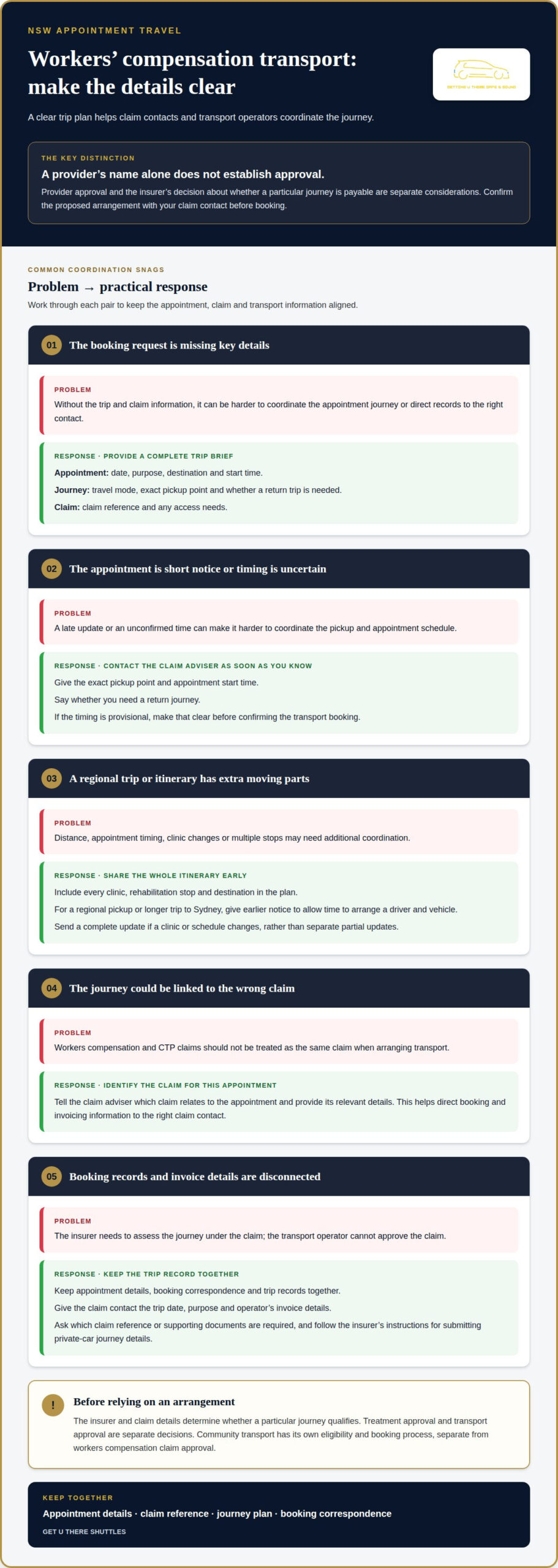
Identify workers compensation and CTP claims separately when arranging transport. Tell the claim adviser which claim relates to the appointment and provide the relevant details. This helps direct booking and invoicing information to the right claim contact, rather than treating the journey as ordinary public transport.
For a workers compensation psychology claim, ask the insurer or claim adviser which psychologists are approved for treatment under that claim. Share the appointment location and time when arranging travel. For primary psychological injuries first notified on or after 1 July 2026, section 8G of the NSW Workers Compensation Act 1987 lists relevant events; the injury must also have a real and direct connection to employment, with employment as the main contributing factor.
When transport is needed for a medical appointment in Newcastle or elsewhere in NSW, the claim purpose, destination and travel plan help establish the arrangement. Keep appointment details and booking correspondence together for the insurer. A transport booking is not an emergency medical response; call Triple Zero on 000 for urgent medical assistance.
No transport provider is automatically approved by name. Eligibility depends on the insurer and the details of the claim and journey. Check the proposed provider and arrangement with your claim contact before booking.
Booking coordination with claim advisors and case managers
In NSW, workers compensation does not make every taxi, public transport or private-car journey automatically payable. The claim, appointment purpose and insurer’s arrangements determine how travel is handled.
To book and claim appointment transport, give the claim adviser the appointment date, travel mode, pickup and destination, and return-trip requirements. Include the claim reference and any access needs, then follow the insurer’s instructions about approval and records. For a private-car journey, keep the trip details for your claim submission.
Eligibility can depend on the journey’s connection to treatment and the claim arrangements. If an employer or rehabilitation provider organised the appointment, include their contact details so schedule changes can be coordinated. Taxi or public transport may require different booking records from a private-car trip, so state the travel mode clearly in your request.
For short-notice appointments, contact the claim adviser as soon as you know the time and location. Give the exact pickup point and appointment start time, and say whether you need a return journey. If the timing is still provisional, make that clear before confirming a transport booking.
Regional travel and multiple stops may need extra coordination. Share the full itinerary, including any clinic change or rehabilitation stop, instead of sending separate, partial updates. Earlier notice gives the claim contact and transport operator more time to coordinate the journey.
Community transport has its own eligibility and booking process. Its assessment is separate from workers compensation claim approval, so clarify which arrangement applies before relying on it for an appointment journey. The relevant community transport arrangement determines its booking process and any passenger contribution.
Keep appointment changes and transport correspondence together, especially when the insurer, case manager and rehabilitation provider are coordinating different parts of the trip. For help arranging a journey, include the same practical details in your appointment transport enquiry.
Insurer-direct invoicing and transport costs
Insurer-direct invoicing depends on the claim arrangements and the information provided with the booking. Keep transport approval separate from treatment approval, and clarify the insurer’s invoicing process before travelling.
Insurer and case manager coordination
The insurer assesses whether a journey is payable under the workers compensation claim. A case manager can help coordinate the appointment record, booking details and invoice routing with the employer or rehabilitation provider. Give the claim contact the trip date, purpose and operator’s invoice details, and ask which claim reference or supporting documents are required. This helps connect the transport record to the right claim.
Payment and approval decisions
The insurer decides whether workers compensation transport is payable; the operator cannot approve the claim. If an invoice is declined, ask the claim contact for the reason and provide relevant appointment or booking records. If direct invoicing has not been arranged, ask how the insurer wants the expense submitted before travelling. The same applies to private vehicle mileage claims: keep the journey details and follow the insurer’s submission requirements.
Treatment pre-approval and transport approval are separate decisions. In NSW, treatment within the first 48 hours of a work injury is an exception to the insurer pre-approval requirement for treatment. That exception does not automatically approve travel. Ask the claim contact to identify which decision applies to each part of the arrangement.
Transport industry context does not determine an individual claim. Small businesses make up 92 per cent of businesses covered for workers insurance in the transport and storage industry. For an injured worker, the relevant considerations remain the claim, appointment purpose and insurer’s travel arrangements.
Transport provider accreditation and driver checks
How can you find a SIRA-approved transport provider in NSW? Ask your insurer or case manager which requirements apply to your journey, then confirm that the proposed booking follows those arrangements. Choosing workers comp approved transport providers in NSW starts with checking the insurer’s requirements, not relying on a provider’s use of the “SIRA-approved” label alone.
Keep two decisions separate: whether the travel expense is accepted under your claim, and whether the operator meets the requirements for the booking. Before travelling, give the insurer the operator’s details, appointment purpose, pickup and destination, and any assistance the injured passenger needs. Request booking or payment instructions in writing so the arrangement is clear before the journey.
Driver suitability is practical as well as administrative. Explain any needs that could affect the trip, such as help getting into or out of the vehicle, a mobility aid or travel to a regional appointment. The operator can then discuss a transport plan based on the passenger’s stated requirements. A standard vehicle or pickup arrangement may not suit every injury or access need.
For a return-to-work or rehabilitation appointment, timing can be part of a managed recovery plan. Share relevant pickup and appointment details with the case manager and rehabilitation provider so changes can be coordinated. If the clinic changes the appointment time, update the booking and claim contact rather than relying on the original schedule.
Before confirming a booking, assess workers comp approved transport providers across NSW against the arrangements for the specific claim and the passenger’s needs. Useful details to clarify include:
- The insurer’s booking and payment instructions for this claim.
- Accurate pickup, destination and appointment information.
- Any assistance the injured passenger needs during boarding or travel.
- How booking confirmation and insurer correspondence will be kept together.
These checks can identify mismatches early, such as a trip booked to the wrong location or a vehicle that does not suit the passenger. The key is to establish the insurer’s requirements for the specific journey, rather than assume that a general accreditation label guarantees payment.
Get U There Shuttles: Worker’s compensation transportation
Get U There Shuttles provides Worker’s compensation transportation for medical appointment trips. If your insurer or case manager has agreed to a transport arrangement, share the appointment time, pickup and destination, return-trip needs and any assistance required. These details help shape a booking around the passenger’s journey.
Insurer approval and provider payment arrangements are separate from organising the trip. Keep your claim contact informed and follow their instructions about the booking and invoice. Get U There Shuttles also provides medical appointment transfers, NDIS transport, Airport Transfers and Cruise Ship Transfers.
Make your next appointment journey easier to organise
For ongoing treatment, a consistent transport routine can make appointment days easier to manage. Keep one up-to-date record of your preferred pickup arrangements, access needs and contact details. Update it whenever your treatment location or travel requirements change, so future bookings start with accurate information instead of guesswork.
Choosing among workers comp approved transport providers in NSW is part of a broader plan for getting to care. Keep transport arrangements aligned with your appointment schedule and claim communications, and raise changes early with the people coordinating your treatment. This practical approach helps keep each journey organised while you focus on recovery.
If you need transport for a workers compensation appointment, contact Get U There Shuttles with the journey details and assistance required. Send a transport enquiry to discuss your requirements and take the next step with confidence.
Frequently Asked Questions
What is workers’ compensation transport?
Workers’ compensation transport is passenger travel connected with an accepted work injury claim, such as a trip to a medical appointment. For example, an injured worker may need a planned journey to a GP, psychologist or rehabilitation appointment. It means getting to and from care, not receiving the treatment itself. The claim and insurer arrangements determine whether the journey is covered.
Is this a medical or emergency transport service?
No. Workers’ compensation appointment transport is a planned passenger journey, not emergency medical care or an ambulance response. It does not provide clinical treatment during travel. If someone needs urgent medical assistance in Australia, call Triple Zero on 000. For a scheduled appointment, give the transport operator relevant mobility or access needs so the journey can be arranged appropriately.
Do I need insurer pre-approval or a referral for medical transport in NSW?
Treatment approval and transport approval are separate matters. In NSW, treatment within the first 48 hours of a work injury is an exception to the insurer pre-approval requirement for treatment; that exception does not automatically approve travel. A referral relates to clinical care, while transport payment follows the claim’s arrangements. Ask the claim contact what booking information they need for your trip.
Can an injured worker use a preferred transport provider or choose their own provider?
You can tell your insurer or case manager which provider you prefer and why, such as needing a particular pickup arrangement. A preference alone does not mean the insurer will pay the provider directly or accept the expense. Share the operator’s details and journey requirements with the claim contact, and get payment instructions before confirming a booking to avoid confusion about the invoice.