
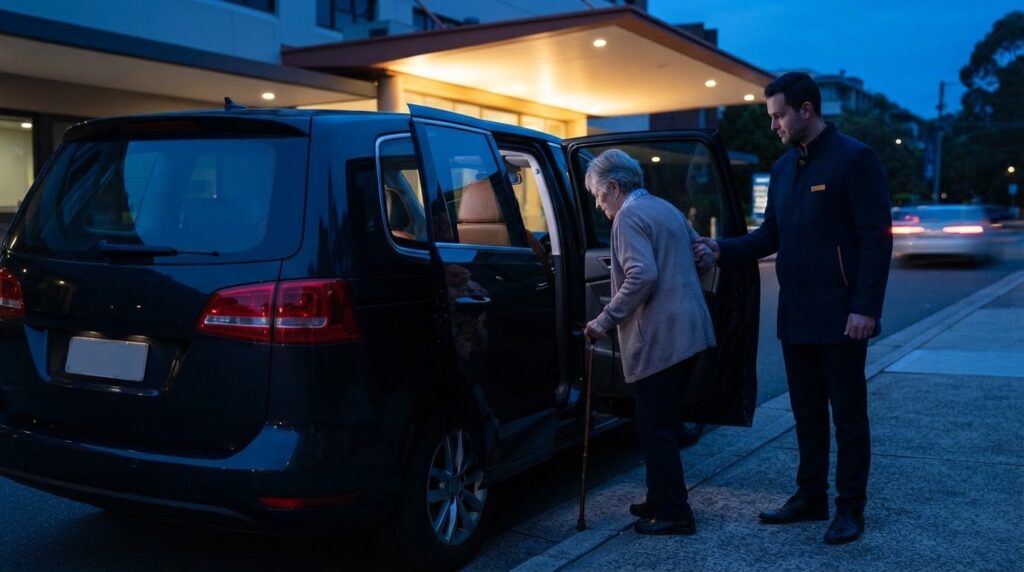
In NSW, patients are generally expected to arrange their own transport to healthcare appointments. A dedicated medical appointment car service in NSW provides a pre-arranged trip to a hospital, clinic or treatment, planned around the passenger’s needs. For people with limited mobility or other transport barriers, practical assistance and a suitable vehicle can make the journey easier to manage.
It’s understandable to want reassurance about the trip there and home, particularly when an appointment involves treatment or extra care. This article explains how vehicle suitability, driver assistance and clear planning can support medical trips, and what to consider when arranging transport. You’ll also see how private medical transfers fit alongside other NSW transport options, helping you choose a plan suited to the journey.
Key Takeaways
- Match the vehicle and assistance arrangements to the passenger’s mobility needs before planning a clinic trip.
- Understand when travel distance for specialised treatment may make IPTAAS support relevant.
- Plan the journey around appointment timing, pickup and return arrangements, and any support the passenger needs.
- Use the trip’s start and destination locations to identify the transport arrangements that best suit travel across NSW.
Accessible vehicles and driver assistance
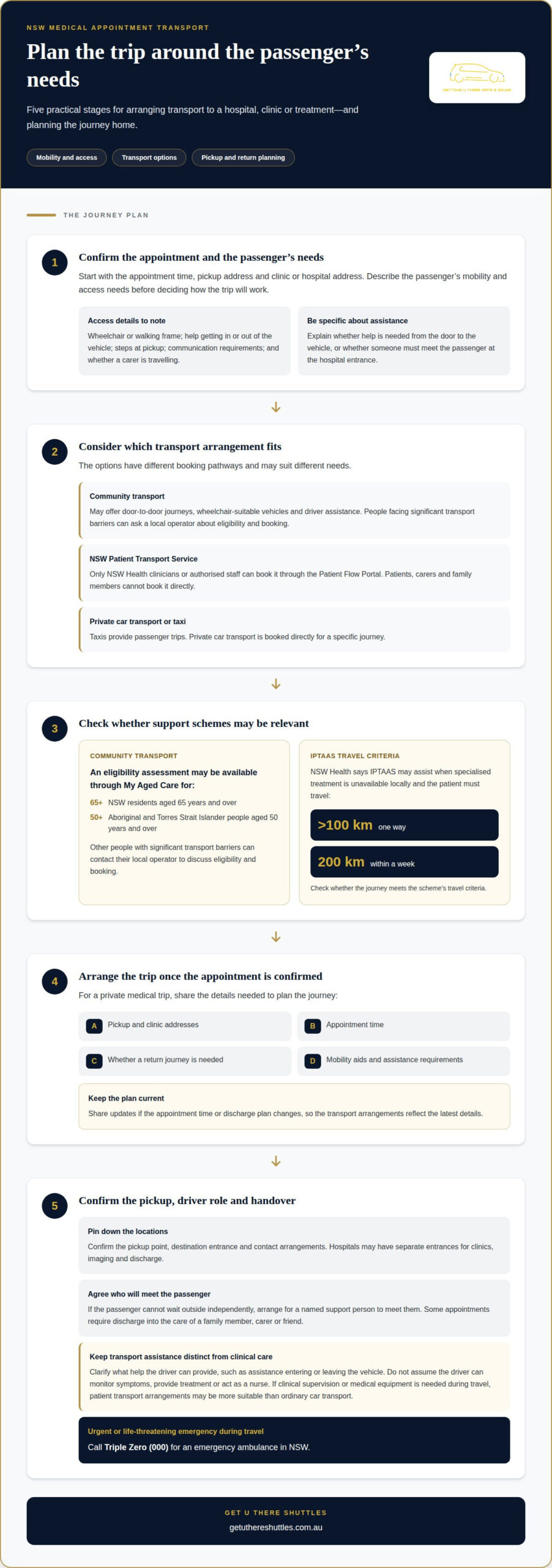
Community transport may provide door-to-door journeys, wheelchair-suitable vehicles and drivers who assist passengers to and from vehicles. NSW Patient Transport Service is different: only NSW Health clinicians or authorised staff can book it through the Patient Flow Portal. Patients, carers and family members can’t book it directly. Taxis provide passenger trips, while private car transport is booked directly for a specific journey.
Before arranging a dedicated medical appointment car service in NSW, describe the passenger’s access needs clearly. Note whether they use a wheelchair or walking frame, need help getting in or out of the vehicle, or must navigate steps at pickup. Provide the pickup and clinic addresses, and say whether a carer is travelling. These details help shape the transport plan around the passenger’s needs.
Driver assistance and first-aid training are separate from vehicle access. Explain what help the passenger needs and clarify the driver’s role. Don’t assume a transport driver provides clinical care or monitoring. For example, distinguish help moving from the door to the vehicle from medical support needed during treatment or travel. For individuals who require personalised assistance or companion travel, disability care providers like Pursue Ability can arrange dedicated support workers to accompany passengers to and from their appointments.
Fitness to Drive is a separate medical and licensing matter. Medical practitioners assessing a patient’s fitness to drive in NSW should refer to Assessing Fitness to Drive. Transport for NSW accepts a medical practitioner’s letter when it contains enough information to decide fitness to drive. The Fitness to Drive online forms changed on 18 May 2026; practitioners can manually overwrite reduced medical review frequency for 17 medical conditions.
For forms, a Transport for NSW medical report isn’t valid if completed by a Registered Nurse. Under regulation 60 (1)(c) of the Road Transport (Driver Licensing) Regulation 2017, it must be completed by a registered practitioner or specialist. Keep that medical paperwork separate from transport booking details, such as mobility aids and pickup access.
In reviewing this paperwork, keep the qualification requirement explicit: a Transport for NSW medical report completed by a Registered Nurse is not valid; regulation 60 (1)(c) of the Road Transport (Driver Licensing) Regulation 2017 requires completion by a registered practitioner or specialist. This is a report-author requirement, distinct from the passenger’s access details.
Hospital clinic and treatment trips
Plan a hospital visit around the appointment schedule and the passenger’s ability to travel afterwards. Some NSW healthcare appointments require discharge into the care of a family member, carer or friend. Decide who will meet the patient before treatment begins, particularly if they may need help leaving the clinic.
Community transport may be an option when mobility, disability, health issues, language challenges or limited public transport restrict access to travel. NSW residents aged 65 years and over, and Aboriginal and Torres Strait Islander people aged 50 years and over, may contact My Aged Care for a community transport eligibility assessment. Other people facing significant transport barriers can contact their local operator to discuss eligibility and booking.
Government support may also apply to travel for specialised treatment. NSW Health says IPTAAS may assist when treatment is unavailable locally and a patient must travel more than 100 km one way or 200 km within a week. This can help patients consider whether a distant appointment meets the scheme’s travel criteria.
Can NSW residents access support through community transport or government schemes? Yes, eligibility depends on each programme’s criteria, which may relate to transport barriers or travel for specialised treatment. Contact My Aged Care or a local community transport operator to start an assessment or enquiry.
For a private medical trip, arrange transport once the appointment is confirmed. Provide the pickup and clinic addresses, appointment time, whether a return journey is needed, and any assistance requirements. Share updates if the appointment time or discharge plan changes, so the arrangements reflect the latest details.
If a private journey suits your appointment, explore medical appointment transfers for transport arranged around your trip.
Passenger safety
Safe medical travel starts with a clear description of the passenger’s needs. Tell the transport service about mobility aids, difficulty entering a vehicle, communication requirements and help needed at pickup. Explain, for example, whether someone must meet the passenger at the hospital entrance or accompany them home. This helps organise transport assistance without confusing it with clinical care.
Before travelling, confirm the pickup point, destination entrance and contact arrangements. Large hospitals may have separate entrances for clinics, imaging and discharge, so include the correct location in the booking details. If the passenger can’t wait outside independently, arrange for a named support person to meet them. Keep appointment information and relevant contact details accessible during the trip.
Clarify what the driver’s role covers, including help entering or leaving the vehicle, and what falls outside that role. Don’t assume a driver can monitor symptoms, provide treatment or act as a nurse. If the passenger needs clinical supervision or medical equipment during travel, patient transport arrangements may be more suitable than ordinary car transport.
Before booking, read the service’s safety and cancellation terms, including how waiting time is handled, what happens if an appointment runs late, and whether the return trip is included or arranged separately. Confirm the pickup contact and the process for updating the driver if discharge timing changes.
For the return journey, decide who will meet the patient after treatment and where the vehicle should collect them. Some NSW appointments require discharge into the care of a family member, carer or friend. Include that handover in the plan rather than assuming the patient can leave alone.
If someone’s condition becomes life-threatening or urgent during travel, call Triple Zero (000) for an emergency ambulance in NSW. A car journey isn’t a substitute for emergency response. For a planned trip, share relevant assistance needs beforehand and keep the passenger’s phone within reach, so they can contact their support person if arrangements change.
Community transport costs in NSW vary by operator and area, so passengers should contact their local operator to check the cost. Confirm the applicable charge before booking, as the amount depends on the service and location.
What areas of NSW do medical appointment car services cover?
Coverage depends on the transport service, pickup location and medical destination. A trip within Sydney may need a different route plan from travel between a regional town and a specialist clinic. Don’t assume that a service covering one suburb also covers every NSW region. Provide both addresses when arranging the journey.
Write down the passenger’s home suburb and the hospital or clinic suburb, such as a trip from Parramatta to a Sydney hospital. For a longer journey, include the treatment location and whether a return trip is needed. These details help plan the route and arrange the trip.
Regional travel needs careful planning around appointment timing and the return journey. A patient travelling from Dubbo to a specialist appointment should share the appointment time, pickup point and any mobility assistance required. If treatment could affect the passenger’s ability to travel alone afterwards, include the planned handover arrangements.
Before booking, organise the details that define the service area and trip:
- Pickup: the full street address and suburb, including the preferred entrance.
- Destination: the hospital, clinic or treatment address and the relevant entrance, if known.
- Journey plan: whether transport is one-way or return, and the appointment time.
- Passenger needs: mobility aids, assistance getting in or out, and whether a carer is travelling.
These details help distinguish a direct appointment journey from a multi-stop trip, such as collecting a passenger before continuing to a clinic. If the appointment location changes, update the route details before travel so the pickup and destination remain clear.
To discuss a NSW medical trip, send your pickup and destination details with the appointment time and assistance needs.
Get U There Shuttles: Airport Transfers
Get U There Shuttles provides medical appointment transfers and Airport Transfers. To request a quote, complete the enquiry form with your pickup and destination addresses, travel date and time, passenger details, and any assistance needs. The team will be in touch within 24 hours with a quote.
If your booking is urgent, or you need help completing the form, call Get U There Shuttles on 1300 66 88 48.
Plan your next journey with confidence
Before arranging a dedicated medical appointment car service in NSW, decide who will coordinate changes to the travel plan. A family member, carer or passenger can keep appointment updates and transport details together, making it easier to respond if plans change.
When you’re ready to take the next step, send your transport enquiry. A clear plan can help make the journey feel more manageable.
Frequently Asked Questions
What dedicated medical appointment car services operate in NSW?
NSW options include private medical appointment transfers, community transport, the NSW Health Patient Transport Service and taxis. Get U There Shuttles provides private medical appointment transfers and NDIS transport. These options suit different needs: someone arranging a planned clinic visit may choose a private booking, while Patient Transport Service trips must be booked through authorised NSW Health clinicians or staff.
Which NSW medical transport services provide door-to-door or door-through-door assistance?
Community transport may provide door-to-door journeys, with drivers assisting passengers to and from vehicles. Door-through-door assistance goes beyond the vehicle, for example by accompanying someone inside a building. Don’t assume every transport option includes this level of help. For a clinic trip, describe the support needed, such as help reaching reception, so the arrangements match the journey.
Can these services transport wheelchair users, people with mobility aids, or passengers who need an escort?
Some NSW community transport services offer wheelchair-suitable vehicles, and passengers can explain mobility aid or escort needs when arranging a trip. For example, state whether a wheelchair user will remain seated in it during travel, and whether a support person is accompanying them. Private medical transfers and NDIS transport are other options to consider for planned journeys, with passenger requirements outlined during booking. For NDIS participants in areas such as Newcastle and the Hunter who need support attending appointments or accessing the community, providers like paramountcaresolutions.com.au offer tailored disability care services.